
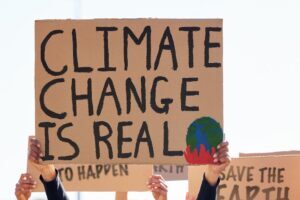




When a major winter storm hits, a familiar “gotcha” often follows: If it’s freezing, where’s global warming? During this latest storm cycle, President Donald Trump repeated that kind of message publicly—treating extreme cold as evidence that warming isn’t real.
Here’s the problem: that question mixes up weather and climate—and it sets a trap where people skim one line (“climate change didn’t cause this storm”) and walk away thinking climate change had nothing to do with risk.
A more accurate, skimmer-proof truth is this:
Two things can be true at the same time:
- Winter storms are driven by weather patterns.
- A warming climate changes the background conditions those storms move through—especially moisture and temperature thresholds—which can change impacts.
This doesn’t require exaggeration. It’s how the climate system works.
Weather is the event. Climate is the pattern.
Weather is what happens today: a storm, a cold snap, an ice event.
Climate is the long-term pattern: the trend across decades, across regions, across the planet.
A cold week in one country can happen inside a warming world—just like one down day doesn’t reverse a long-term trend in anything else that’s measured over time.
That’s why scientists push back on “where’s global warming?” claims: they treat a short local snapshot as if it cancels long-term global measurements.
“Global warming” doesn’t mean “no more cold”
“Global warming” is a shorthand for the fact that Earth’s long-term average temperature has risen. But the name can mislead people into thinking it means:
- every day gets warmer
- every place gets warmer equally
- winter disappears
- snow becomes impossible
None of that is required for global warming to be true.
A warming climate doesn’t erase winter. It shifts the odds and the boundaries—and that’s where the real story sits.
How warming can make winter storms hit harder
This is the key idea people miss:
More moisture in the air can raise the ceiling on precipitation
Warmer air can hold more water vapor. When storms form, that moisture can be converted into precipitation.
In winter, that can show up as:
- heavier snow (if the storm stays cold enough), or
- more sleet/freezing rain (if temperatures hover near the freezing point)
This is one reason a warming world can still produce punishing winter events: storms don’t need a cold planet—they need cold-enough air plus moisture.
Near-freezing temperatures can be the most disruptive zone
Many of the worst winter impacts happen when temperatures sit around the freezing line.
That’s where you get:
- rain that freezes on contact
- ice coating roads, trees, and power lines
- heavy, sticky snow that snaps limbs and drops lines
- rapid thaw/refreeze cycles that turn slush into glass
If you want a practical takeaway, it’s this: an ice storm is often more grid-damaging than a snowstorm, and the freezing line is where storms become chaotic.
Climate change doesn’t “invent” storms—but it can shape consequences
Winter storms are built from atmospheric dynamics that existed long before modern emissions. The more accurate statement is:
Climate change doesn’t create every storm. It changes the conditions storms move through.
That can mean:
- more moisture available to fuel heavy precipitation
- different rain/snow/ice outcomes along the storm track
- a higher chance of disruptive “threshold weather” near freezing
- higher impacts when systems are already stressed
The honest part: what we can’t claim (and why that matters)
It’s tempting to say: “Climate change contributed to this storm.”
But for a specific storm, that statement needs a specific tool:
Event attribution is how you quantify influence on one event
Attribution studies estimate whether human-caused warming made an event more likely or more intense, and by how much—by comparing today’s climate to a modeled world without human influence.
Without that analysis, it isn’t responsible to claim climate change “caused” the storm—or to assign a percentage to its role.
What we can say with high confidence
Even without a storm-specific attribution study, it is scientifically accurate to say:
- The climate background is warmer than it used to be.
- Warmer air increases the potential for heavy precipitation.
- Storm impacts depend heavily on infrastructure and vulnerability.
So a cold storm doesn’t refute warming. And “not caused by” is not the same thing as “not influenced by.”
What’s changed
This storm cycle highlighted something many people feel but don’t always name:
The storm is weather. The scale of harm is systems.
A winter storm becomes a crisis when it meets:
- overhead lines exposed to ice and wind
- tree canopies that drop limbs into the grid
- homes that lose heat quickly
- tight travel networks that cascade delays
- communities with unequal access to backup heat, safe shelter, and rapid recovery
The weather is the spark. The system is the amplifier.
The “where’s global warming?” meme misses the real question
The real question isn’t “why is it cold today?”
It’s:
- Why do outages cascade so easily?
- Why does recovery take longer?
- Why do extreme events create bigger disruption than they used to?
Those are the questions that matter if you want fewer emergencies—and they’re compatible with the fact that winter can still be bitterly cold.
A skimmer-proof way to explain it in one line
If someone only reads one sentence, make it this:
Climate change doesn’t invent storms. It changes the playing field.
Storms still happen. But the “field” now has different moisture, different thresholds, and different vulnerabilities—so the same category of storm can have different consequences.
How to respond when someone says “Where’s global warming?”
Use whichever version matches your energy:
One-sentence version
“Climate is long-term global trends; weather is short-term local conditions. A cold snap doesn’t cancel decades of warming.”
“Playing field” version
“Storms still form naturally—climate change shifts the conditions storms move through, like moisture and the freezing line.”
“Loaded dice” version
“You can still roll a low number, but the odds shift over time.”
Low-carbon home preparation that reduces risk
Preparedness gets marketed as buying more. The lowest-impact approach is different:
Reduce heat loss, reduce peak demand, and reduce dependence on emergency systems.
Weatherize first (the highest-return prep)
- Weatherstrip doors; add a door sweep
- Seal obvious drafts around windows and penetrations
- Prioritize attic access sealing and insulation
- Insulate exposed pipes (also reduces freeze risk)
Use passive heat like a system
- Open sun-facing curtains in daytime
- Close curtains/blinds at night
- “Zone” into one core room during peak cold
- Add warmth where you already live (rugs, layers) before turning to new gadgets
Outage readiness without waste
Choose durable items you’ll reuse:
- rechargeable lantern or LED light
- a reliable power bank kept charged
- a small rotating pantry of foods you already eat
Safety is part of sustainability
- check smoke and CO detectors
- never run grills/ovens/generators indoors or near openings
Avoiding a second emergency is the most sustainable outcome.
FAQs
If the planet is warming, why is it still snowing?
Because many regions are still cold enough in winter for snow, and storms still form naturally. Warming shifts long-term averages and odds; it doesn’t erase variability overnight.
Do cold snaps disprove climate change?
No. Climate is measured over decades and across the globe. Local cold events can occur in a world that is warming overall.
Does climate change make winter storms worse?
It can increase the potential for heavy precipitation by increasing atmospheric moisture. Whether that falls as snow, sleet, freezing rain, or rain depends on temperatures along the storm’s path—especially near the freezing point.
Can climate change be blamed for a specific storm?
Not responsibly without event attribution research that analyzes that specific event.
Final Thoughts
Cold storms don’t disprove global warming.
A more truthful framing is:
Climate change doesn’t create every storm. It changes the conditions storms move through—and that can change the consequences.
If we want fewer crises, we need two things at once: honest science that doesn’t oversimplify, and practical resilience that’s low-carbon, low-waste, and built to last.